.webp)
🚩PIPING Red Flags
When Should You Service or Modify Refrigeration Piping?
Key Indicators Your Piping Needs Attention:
-
Refrigerant leaks or oil residue around joints
-
Poor cooling performance or pressure imbalance
-
Water leaks or clogged drain lines
-
Excessive vibration or pipe movement
-
Frequent service calls or recurring system issues
Piping issues often appear as performance problems, moisture concerns, or repeat service events long before major equipment failure occurs.
Refrigerant Leaks or Oil Residue
Oil staining or refrigerant loss often indicates compromised joints or aging piping connections.
Cooling or Pressure Imbalance
Improper pipe sizing or routing can create pressure drops that reduce system efficiency and cooling capacity.
Drain Line Leaks or Blockages
Restricted or improperly sloped drains can cause condensate overflow and moisture damage.
Vibration or Pipe Movement
Poor support or thermal expansion can stress joints and accelerate wear.
Recurring Service Issues
Repeated service calls may signal underlying piping design or installation deficiencies.

Every Refrigeration Need.
One Reliable Team.

What Is Commercial Refrigeration Pipefitting?
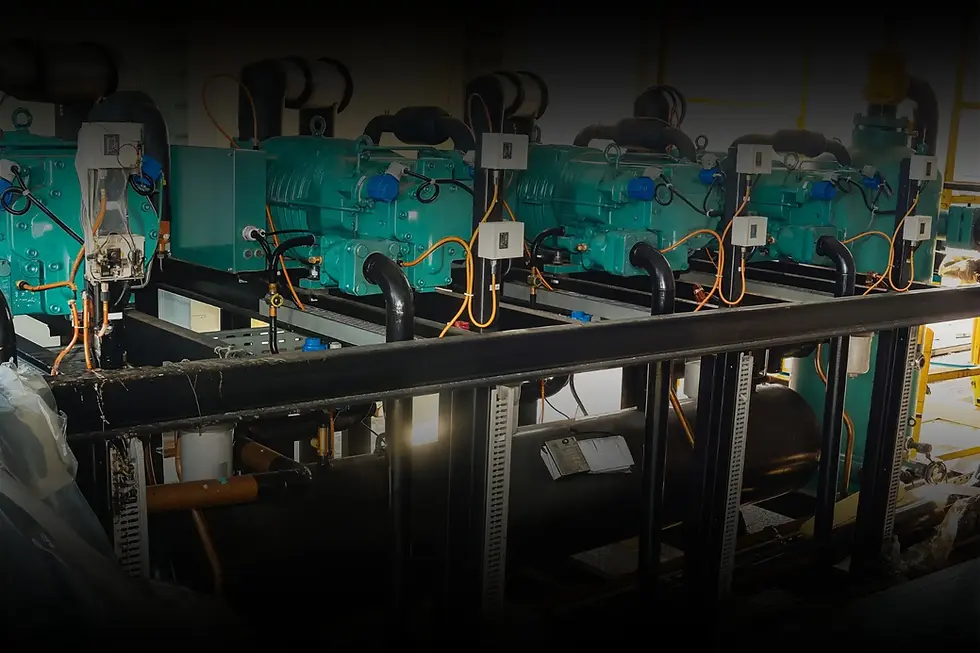
Commercial refrigeration pipefitting is the design, fabrication, and installation of refrigerant piping and drain lines that connect compressors, condensers, evaporators, and auxiliary equipment into a fully functioning system. These piping networks control how refrigerant moves, how oil returns to compressors, and how condensate drains safely away from equipment.
Proper pipe sizing, routing, slope, insulation, and joint quality directly affect system efficiency, pressure stability, leak prevention, and long-term serviceability. Poor piping design can lead to oil return problems, pressure drop, moisture buildup, vibration damage, and premature equipment failure.
Engineered Temperature Solutions engineers piping systems to support proper refrigerant flow, stable pressure control, clean drainage, and reliable long-term operation across commercial refrigeration and cold storage environments.

PRECISION FLOW CONTROL
Proper pipe sizing and routing maintain balanced refrigerant flow and pressure stability.
CLEAN DRAIN MANAGEMENT
Correct drain line slope and trapping prevent moisture buildup and overflow issues.
LEAK-RESISTANT INSTALLATION
High-quality joints and materials reduce long-term leak risk and service disruption.
SYSTEM-LEVEL INTEGRATION
Piping is engineered to coordinate with compressors, condensers, and controls for reliable operation.






ETS HVAC Insights
Go inside our commercial HVAC projects and discover how ETS helps Central Ohio businesses upgrade systems, solve problems, and improve building performance year-round.


Frequently Asked Questions
Commercial refrigeration pipefitting is the design and installation of refrigerant piping and drain lines that connect compressors, condensers, evaporators, and related equipment into a functioning system.
Proper piping design controls refrigerant flow, pressure stability, oil return, and condensate drainage, directly impacting system performance and longevity.
Refrigerant lines move refrigerant between the compressor, condenser, and evaporator to transfer heat and maintain cooling performance.
Drain lines safely remove condensate from evaporators and prevent water buildup, overflow, and moisture-related damage.
Poor pipe sizing, routing, or slope can cause pressure drops, oil return problems, vibration, leaks, and reduced cooling capacity.
Copper and steel piping are commonly used depending on refrigerant type, system pressure, and application requirements.
Pipe sizing is based on refrigerant velocity, pressure drop limits, system capacity, and oil return requirements.
Leaks can result from improper brazing, vibration, thermal expansion, corrosion, or aging piping components.
Routine inspections help identify leaks, insulation damage, drain restrictions, and mechanical stress before system performance is impacted.
In some cases piping can be reused if it meets sizing, cleanliness, pressure rating, and code requirements.
Excessive vibration can weaken joints, cause fatigue cracks, and accelerate refrigerant leaks over time.
Yes. Refrigeration piping must comply with mechanical codes, safety standards, and refrigerant handling regulations.
Proper insulation reduces heat gain, prevents condensation, and protects system efficiency.
Yes. Piping can be rerouted, resized, or extended to support equipment upgrades or capacity changes.
Yes. Engineered Temperature Solutions designs, installs, and services commercial refrigeration piping and drain systems for facilities across Ohio.
Need piping service in Central Ohio? Request a quote or call (614) 289-8733 to get started.
Frequently asked questions

Our Services
ETS delivers complete refrigeration pipefitting services to support proper flow, drainage, and system performance.
Redefine your
buildings HVAC
