Commercial HVAC Chiller Restoration: How ETS Rebuilt a Failing Chiller System

What it takes to diagnose, repair, and restore a forgotten HVAC chiller system to full performance.

When Engineered Temperature Solutions (ETS) was called to evaluate a failing commercial HVAC chiller and a deteriorating commercial HVAC system inside a former UPS facility built in the 1960s, the situation was far beyond a routine service call. What we encountered was a chiller system that had been shut down for more than seven years, a mechanical room suffering from years of neglect, and a building struggling with uncontrolled heat even during Ohio’s cold winter months.
Indoor temperatures were regularly climbing above 85°F without air conditioning, creating uncomfortable and inefficient operating conditions. Controls were obsolete. Pumps had failed. Coils were clogged. The cooling tower had rusted beyond use. This wasn’t just one failed component — this was a complete breakdown of an aging commercial HVAC system that had quietly deteriorated over decades.
What followed was a full-scale HVAC chiller and mechanical system revival — one that transformed a neglected infrastructure into a fully operational, modernized commercial chiller system delivering precise 66°F climate control across the building.
The Reality of Aging Commercial HVAC Systems

Buildings constructed in the 1960s were never designed to operate under today’s internal heat loads, energy efficiency expectations, or occupancy demands. Over time, many of these facilities rely on patchwork repairs instead of true system-level engineering. Deferred maintenance compounds. Controls become obsolete. Cooling components get abandoned rather than restored.

This facility was a textbook example of what happens when a commercial HVAC system is kept running without long-term engineering oversight. Critical components were still physically present, but operationally disconnected from each other. The HVAC chiller had been offline for years. The cooling tower was no longer usable. The building was essentially functioning without centralized cooling.
ETS was brought in not just to “fix the AC” — but to diagnose, modernize, and resurrect the entire chiller system safely and correctly.
Initial Mechanical Room Conditions: Unsafe, Inefficient, and Inoperable

The mechanical room told the full story the moment our technicians stepped inside.
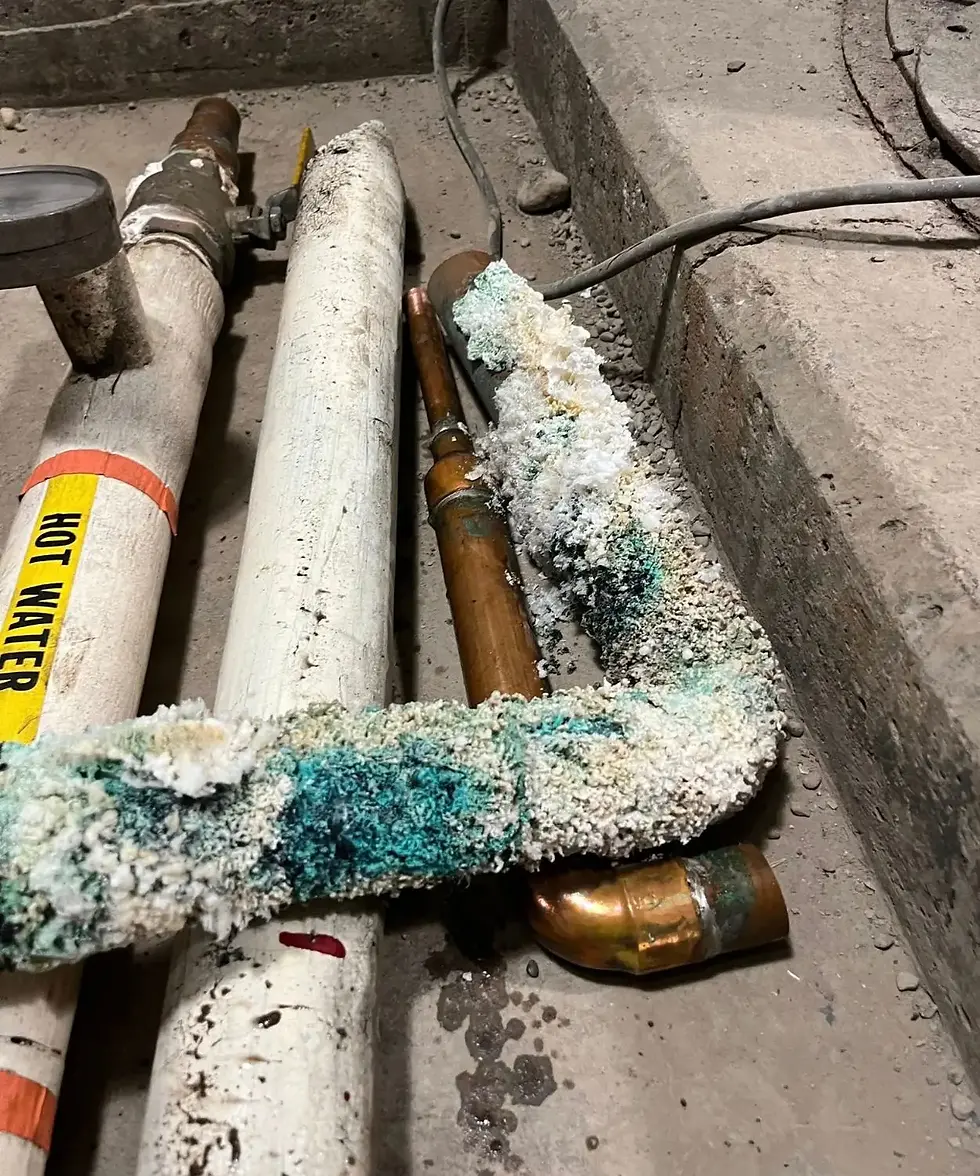
Lighting was minimal. Trash and debris littered portions of the floor. There were active water leaks, heavy corrosion on piping, aging insulation falling apart, failed circulation pumps, and limited service access around critical equipment.
The commercial chiller sat dormant, coated with years of grime and rust. Gauges were unreliable. The cooling infrastructure had been effectively abandoned. This type of environment is not only inefficient — it’s unsafe for both technicians and building occupants.
Before any equipment could be restored, the ETS team implemented a full mechanical room safety assessment and system diagnostic process.
Learning the Original Chiller System Design

Unlike modern packaged systems, legacy chiller systems were often custom-engineered to the specific building.
Before replacing parts, ETS engineers needed to fully understand the original hydronic layout, piping logic, pump configuration, and heat rejection design.
This process involved:
Tracing chilled and condenser water piping
Identifying abandoned vs. active loops
Evaluating heat coil distribution
Testing control communication pathways
Verifying which components could still be safely restored
This step alone is what separates a true HVAC chiller engineering project from a basic service call. Without understanding how the building was originally designed to move heat, any repair would be temporary at best.
Modernizing the Control System: From Legacy Carrier to Prolon

One of the most critical failures in this facility was the outdated Carrier control system.
The original controls were no longer able to:
Communicate properly with the chiller
Regulate temperature accurately
Stage equipment efficiently
Provide modern diagnostic feedback
ETS performed a complete controls modernization, replacing the legacy network with:
New programmable thermostats
Updated zoning logic
Modern automation sequencing
This transformation re-established real-time system communication across the commercial HVAC system. Instead of operating blindly, the restored HVAC chiller and air distribution system could now respond dynamically to building demand, just like a modern facility.
Blocked Heat Coils & 3-Way Valve Failure

During hydronic testing, ETS uncovered another hidden performance killer:
The building’s heat coils had never been properly maintained because no access panels had ever been installed.
Years of dust, debris, and contamination had completely restricted airflow and heat transfer. In addition, multiple 3-way control valves had failed, preventing accurate water temperature modulation.
ETS resolved this by:
Cutting proper service access points into the ductwork
Performing deep, professional coil cleaning
Restoring heat transfer surfaces
Installing new 3-way control valves
Rebalancing the hydronic flow
This step alone dramatically improved system responsiveness and prepared the building for proper heating and cooling staging once the commercial chiller was brought back online.
Why the Commercial HVAC Chiller Was Forced Out of Operation

The root cause of the HVAC chiller shutdown became clear during the inspection of the cooling tower. The original rooftop tower had suffered extreme corrosion over decades of exposure. Structural evaluation revealed that the roof could no longer safely support a new cooling tower of proper tonnage.
Without a functioning cooling tower, the chiller had no way to reject heat. Over time, leaks formed, refrigerant escaped, and the system was eventually shut down entirely — not because it was unrepairable, but because the support infrastructure had failed.
This is a common but costly failure path for aging commercial chiller systems.
Installing a New Ground-Mounted Cooling Tower

Rather than repeating the same rooftop structural risk, ETS engineered a safer and more serviceable solution:
A new ground-mounted cooling tower
Improved accessibility for maintenance
Elimination of roof load concerns
Increased long-term reliability
This single upgrade restored the building’s ability to safely reject heat from the HVAC chiller, a prerequisite for bringing the system back to life.
Commercial HVAC Chiller Revival: Leak Detection, Evacuation & Recharge

With heat rejection restored, attention turned back to the commercial chiller itself. Inspection revealed a critical issue:
Both stages of the chiller were completely empty of refrigerant.
This condition doesn’t occur overnight. It is the result of long-term leakage and neglect.
ETS performed a full revival process that included:
Advanced electronic leak detection
System isolation and evacuation
Pressure testing across circuits
Verification of compressor integrity
A full recharge using 110 pounds of R-134a refrigerant
Factory-spec startup and commissioning
Once energized, the HVAC chiller successfully returned to stable, efficient operation — effectively coming back from what many would call “mechanical death.”
Failed Pumps Restored & Hydronic Circulation Rebalanced

Even a fully operational chiller cannot function without reliable water movement. Several circulation pumps had failed during the years of inactivity.
ETS repaired and restored the pumping system to ensure:
Proper chilled water flow through coils
Stable pressure across distribution loops
Balanced heat absorption and rejection
Maximum coil performance
With pumps restored, the HVAC chiller could now deliver its cooling capacity to occupied spaces, not just generate it in the mechanical room.
Transforming the Mechanical Room from Hazard to Asset

By the final phase of the project, the mechanical room no longer resembled the hazardous environment ETS encountered on day one. The space was transformed into a clean, illuminated, serviceable mechanical plant.
Improvements included:
Leak elimination
Lighting restoration
Debris removal
Safer working clearances
Organized hydronic layout
Reliable automation control panels
This transformation not only restored equipment operation — it restored long-term serviceability, which is critical for protecting the investment made in the commercial HVAC system.
The Final Result: Stable 66°F Comfort Restored
Before rehabilitation, the building routinely exceeded 85°F, even in winter, due to extreme internal heat loads and zero cooling capacity.
After ETS completed the HVAC chiller revival:
The system now cycles consistently at 66°F
Zoning control is fully responsive
Heating and cooling staging is precise
Indoor comfort is stable and predictable
Energy waste has been dramatically reduced
The customer summarized the transformation best:
“This is the best it has felt in here in over 15 years.”
What This Project Teaches About Commercial HVAC Systems
This project is a powerful lesson for owners of aging commercial buildings:
Chiller systems are rarely beyond repair — they are usually beyond maintenance.
Control system modernization often delivers greater gains than equipment replacement alone.
Deferred maintenance will always cost more in the end.
Engineering-based restoration can extend system life by decades.
Indoor comfort is the result of the entire system working together — not just one component.
Replacing an entire commercial HVAC system can cost hundreds of thousands of dollars. System revival, when done correctly, often restores performance at a fraction of replacement cost.
Why Engineered Temperature Solutions Was the Right Partner

This project required far more than basic HVAC service.
It demanded:
Large-tonnage HVAC chiller expertise
Hydronic system diagnostics
Control system modernization
Pump and valve restoration
Full mechanical room rehabilitation
Safe refrigerant handling and commissioning
Engineered Temperature Solutions specializes in engineering-driven commercial HVAC and chiller system restoration, not just component replacement.
Our approach focuses on:
Long-term reliability
Energy efficiency optimization
Safe infrastructure design
Sustainable system revival
Precise temperature control
Need Professional Commercial HVAC Chiller or Commercial HVAC System Restoration?
If your building is experiencing:
Unstable temperatures
Aging chiller performance
High energy costs
Obsolete controls
Abandoned cooling infrastructure
Engineered Temperature Solutions delivers engineering-grade HVAC chiller restoration and commercial HVAC system rehabilitation across Columbus and Central Ohio.

We revive systems—not just replace parts.
Table of Contents


Comments