
Commercial HVAC Replacement vs. Controls Upgrade: Which Comes First?

A straightforward guide to deciding what your facility needs—and where to invest first.

Should you replace your HVAC equipment or upgrade its controls first?
Start with what is causing the problem.
If the equipment is in good condition but runs at the wrong times or responds poorly to temperature changes, controls may deserve attention first.
If it keeps breaking down or can no longer meet your building’s needs, replacement may be the better investment.
Sometimes, the right approach is to plan both together.
For facility managers and building owners in Columbus and Central Ohio, the commercial HVAC replacement decision should begin with a system evaluation—not a quote for a new unit.
Here’s how to compare the options.
First, Separate the Equipment From Its Controls
Equipment does the work. Controls tell it when and how to work.
Your rooftop units, boilers, and other equipment provide heating, cooling, or airflow.
Thermostats, sensors, controllers, and building automation systems help coordinate their operation.
A new unit will not automatically fix an incorrect schedule. Better controls will not repair a damaged heat exchanger.
There is also a less expensive possibility worth checking: repairing or adjusting what you already have.
PNNL’s building re-tuning guidance describes ways to investigate and correct operating problems, including schedules, economizers, and zone controls. [1]
Before approving a major project, ask: “What evidence shows this is the problem?”
Commercial HVAC Replacement: What Should You Check First?
Gather a few useful records before meeting with your contractor:
Recent service reports and repair invoices.
Equipment models and approximate ages.
Areas affected by comfort complaints.
Building hours and any after-hours activities.
Available temperature readings, alarms, and operating records.
You do not need to diagnose the system yourself. You need enough information to describe what is happening.
DOE’s rooftop-unit evaluation process starts with an inventory, screens equipment for possible retrofit or replacement, and uses a field evaluation to refine the decision. [2]
Use these common symptoms to guide that conversation:
What you notice | What to ask your contractor |
Equipment runs after everyone leaves | Is that operation required, or is the schedule wrong? |
The same unit keeps breaking down | Is another repair reasonable, or should we plan replacement? |
Only one room is uncomfortable | Is the problem local airflow, a sensor, zoning, or the equipment? |
Problems started after a renovation | Does the system still fit the building’s layout and use? |
Nobody knows how the system operates | What measurements or operating records do we need first? |
A symptom is a starting point, not proof that equipment or controls must be replaced.

Option 1: Improve Controls First
When This Makes Sense
Investigate controls first when the equipment is serviceable but does not operate the way the building needs it to.
For example:
The warehouse is empty, but HVAC remains on its daytime schedule.
Staff repeatedly override settings to stay comfortable.
A sensor reading does not match actual room conditions.
Units do not respond as expected when settings change.
PNNL identifies scheduling problems, improper economizer operation, and unnecessary heating-and-cooling interaction as areas worth investigating. Some problems can waste energy without producing an obvious comfort complaint. [1]
An Improvement Does Not Always Require New Controls
Ask which level of work is actually needed:
Repair: Fix a failed sensor, actuator, or other component.
Re-tune: Correct schedules, settings, and operating instructions using existing controls.
Upgrade: Add or replace controls when necessary functions or support are missing.
Before investing in new controls, find out whether repairs or adjustments can deliver the performance your building needs.
Check What Happens Outside Working Hours
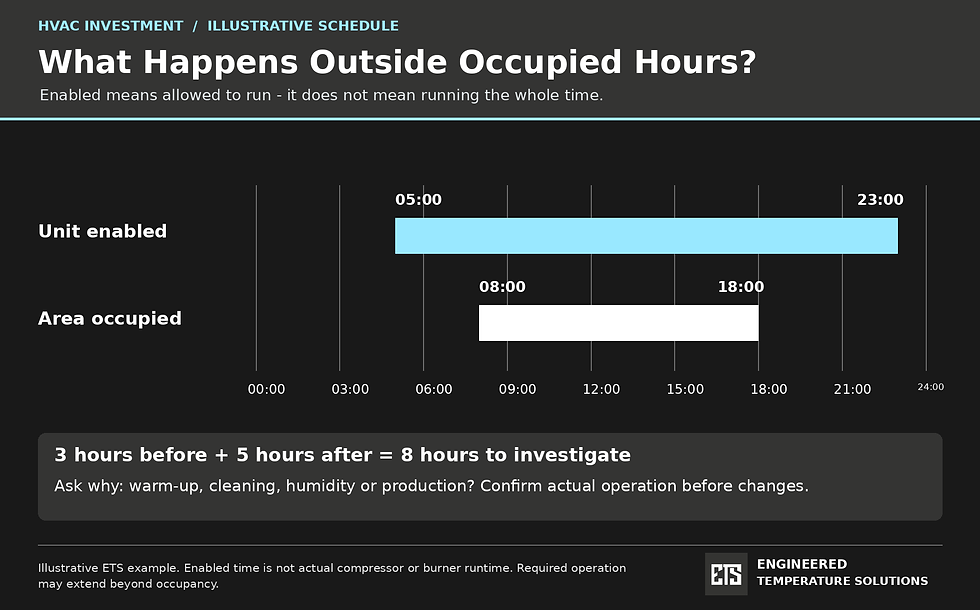
Compare the building’s occupied hours with the hours equipment is enabled to operate.
The example below highlights time worth investigating. It does not show actual compressor or burner runtime, and it does not prove those hours can be eliminated.
Warm-up, cleaning crews, humidity control, and production needs may explain the difference.
Confirm the reason before changing the schedule.
Option 2: Replace Equipment First
When This Makes Sense
Give replacement priority in the evaluation when the equipment itself is limiting reliable performance.
Warning signs worth discussing include:
Repeated failures and increasing repair needs.
Parts that are difficult to obtain.
Documented deterioration or serious mechanical problems.
Equipment that no longer suits the building’s requirements.
Have qualified personnel assess the condition and determine whether repair or replacement is appropriate.
Equipment with a safety concern needs prompt attention, not a controls workaround.
Age Is Only Part of the Decision
An older unit is not automatically a replacement candidate. A newer unit is not automatically the right fit.
DOE’s evaluation process considers condition and usage alongside age and size. [2]
Also consider what happens if the unit fails. Losing comfort in one office and interrupting a critical production area can create very different consequences.
Does Your Current HVAC System Still Fit Your Building?
Has the layout changed? Have operating hours increased? Is new equipment adding heat to the space?
Before choosing a replacement, review what your building needs today. The size and type of equipment originally installed may no longer be the best fit.
Choose a replacement that meets your current needs and addresses the problems you’re experiencing.
Option 3: Plan Equipment and Controls Together
When This Makes Sense
Consider this approach when equipment needs replacing and the controls also need improvement. Planning both together helps avoid compatibility problems, gaps in project scope, and paying for work twice.
Before ordering equipment, confirm:
Compatibility: How will the new equipment connect to your building’s controls?
Responsibility: Who will handle programming, alarms, and system testing?
Handoff: Who will train your team and verify that everything operates as intended?
Berkeley Lab’s integrated rooftop-unit replacement package combines efficient equipment, advanced controls, and energy monitoring. [3] It illustrates why equipment selection and control strategy should be considered together.
Define how the equipment and controls will work together before committing to either.
You Can Still Work in Phases
You do not have to replace equipment and upgrade controls at the same time.
For example, you might replace an unreliable rooftop unit now and upgrade the building’s controls later.
Before purchasing equipment, ask your contractor:
Will the new equipment work with the controls we plan to use later?
Which existing components can we keep, and which need replacing?
Will the next phase require repeating any work or paying additional fees?
What should we include now to make the next phase easier?
Plan ahead so the work you pay for today supports the improvements you make next.

Ask What the New Controls Will Actually Do
“BACnet compatible” does not mean every desired function will work automatically.
BACnet is a communication protocol used in building automation. The BACnet Committee explains that systems still need configuration and sometimes additional programming for a building’s requirements. [4]
Ask your contractor:
What can our staff view and change?
Which operating information will be recorded?
How will alarms reach the right person?
Will we receive access, backups, and training?
What subscriptions or ongoing fees apply?
Include IT staff when the project involves remote access or network changes.
Get these answers in the proposal so everyone understands what is included.
Compare the Full Project, Not Just the Quote
Two proposals may have different prices because they include different work.
Compare installation, controls connections, setup, testing, training, ongoing fees, and expected downtime. Ask what is excluded and who will complete it.
The example below shows why the lowest starting price may not produce the lowest cost once the same required work is included.

Treat Savings Estimates as Estimates
A 2017 PNNL modeling study estimated approximately 29% national commercial-building energy savings potential from packages of improved controls and related measures. [5]
The study shows that better controls can reduce energy use, but actual savings depend on your building and the improvements made.
Ask your contractor how they calculated the projected savings and how they will measure results. The comparison should account for changes in weather, occupancy, and production. If several improvements are proposed, confirm that the same savings aren’t counted twice.
Download the HVAC Investment Planning Worksheet
Use the ETS HVAC Replacement & Controls Evaluation Worksheet to prepare for your next service discussion.
The two-page printable resource helps you:
Describe the problem without needing technical expertise.
Gather records you already have.
Compare two recommendations using the same questions.
Record unanswered questions and the next step.
Complete what you know and write “not sure” where you need help.
Frequently Asked Questions
Can New Controls Make Old Equipment Last Longer?
Better controls may reduce unnecessary runtime and wear, but they cannot repair worn components or guarantee additional years of service.
Have your contractor assess the equipment’s condition before deciding whether a controls upgrade is a worthwhile investment.
Does New Equipment Include Building Automation?
Confirm the scope. Equipment controls, building connections, programming, and testing may be separate parts of the project. [4]
What If We Cannot Afford Both Projects Now?
Ask for a phased plan based on condition, operational risk, and expected benefit. Identify which early investments will remain useful when later work happens.
Get Help Choosing Your Next HVAC Investment
Not sure whether your facility needs equipment replacement, better controls, or both?
Contact Engineered Temperature Solutions to discuss your building’s concerns and arrange a system evaluation.
ETS serves commercial and industrial facilities throughout Columbus and Central Ohio.
Bring your service history, comfort concerns, and future plans so the evaluation starts with what your facility needs.

Key Takeaways
Start with the cause of the problem, not a preferred product.
Check whether existing controls can be repaired or adjusted.
Base replacement decisions on condition, fit, and reliability—not age alone.
Coordinate equipment and controls when both need attention.
Compare complete proposals and verify results after the work.
Sources
Pacific Northwest National Laboratory (PNNL), Building Re-Tuning. Guides to Re-Tuning Measures. — Investigating schedules, economizers, and zone-control problems using operating data.
U.S. Department of Energy, Better Buildings & Better Plants Initiative. RTU Evaluation Methodology. — Equipment inventory, screening, and field evaluation for rooftop-unit retrofit and replacement decisions.
Lawrence Berkeley National Laboratory, Building & Industrial Energy Systems Division. Integrated Systems Packages. — Coordinating equipment, controls, and monitoring during projects such as rooftop-unit replacement.
BACnet Committee (ASHRAE SSPC 135). Frequently Asked Questions. — BACnet communication, configuration requirements, and device capabilities.
Pacific Northwest National Laboratory (PNNL). Cut U.S. Commercial Building Energy Use 29% with Widespread Controls. — Summary of a 2017 national modeling study; aggregate savings potential rather than a project-specific guarantee.


Comments